


In my previous blog, I argued that good rehabilitation is not defined by how a site looks at its peak, or at a certain snapshot, but by how it behaves over time. That naturally leads to the next question:
Behaves compared to what?
This is where analogue (or reference) sites come in, and where rehabilitation monitoring often becomes more powerful and defensible.
In most rehabilitation plans, analogue or reference sites are already defined. They are the nearby areas that represent the target condition the rehabilitated land is expected or desired to move towards. They may also have a set of criteria related to the percentage weed cover or thresholds for slope to reduce erosion risk for example.
This does not mean that they are ideals. They are not pristine. And they are not static.
Analogue sites are simply functioning systems operating under the same climate, soils, and disturbance regime as the rehabilitation area. And they provide a crucial source of context.

Why comparison matters
Rehabilitation doesn’t occur in a vacuum. Rainfall varies from year to year. Droughts and heatwaves occur. Seasons with optimal or poor conditions may alternate. So looking at a rehabilitated area in isolation makes it very difficult to know whether a change reflects progress, failure, or simply weather. And of course let’s not forget the impact that climate change is having, which we haven’t yet quantified.
By comparing rehabilitation areas to analogue sites exposed to the same conditions, much of this ambiguity disappears. This is because both areas experience the same weather, and should also share similar exposure and topographical characteristics. Therefore, if f they behave differently over time, that difference is meaningful.
But asking whether a rehabilitated area is behaving like its analogue does not mean asking whether it looks the same.
It means asking questions such as:
Do both areas green up and senesce at roughly the same times?
Do they respond similarly to rainfall events?
Do they recover after drought at comparable rates?
Is variability increasing, decreasing, or remaining stable over time?
These are behavioural questions. They are about patterns and responses, not about species lists or pixel-level detail.
A case study
To make this more concrete, consider a rehabilitation area at an Australian rehabilitation site, compared with a nearby area selected as an analogue based on similar landform and soils.
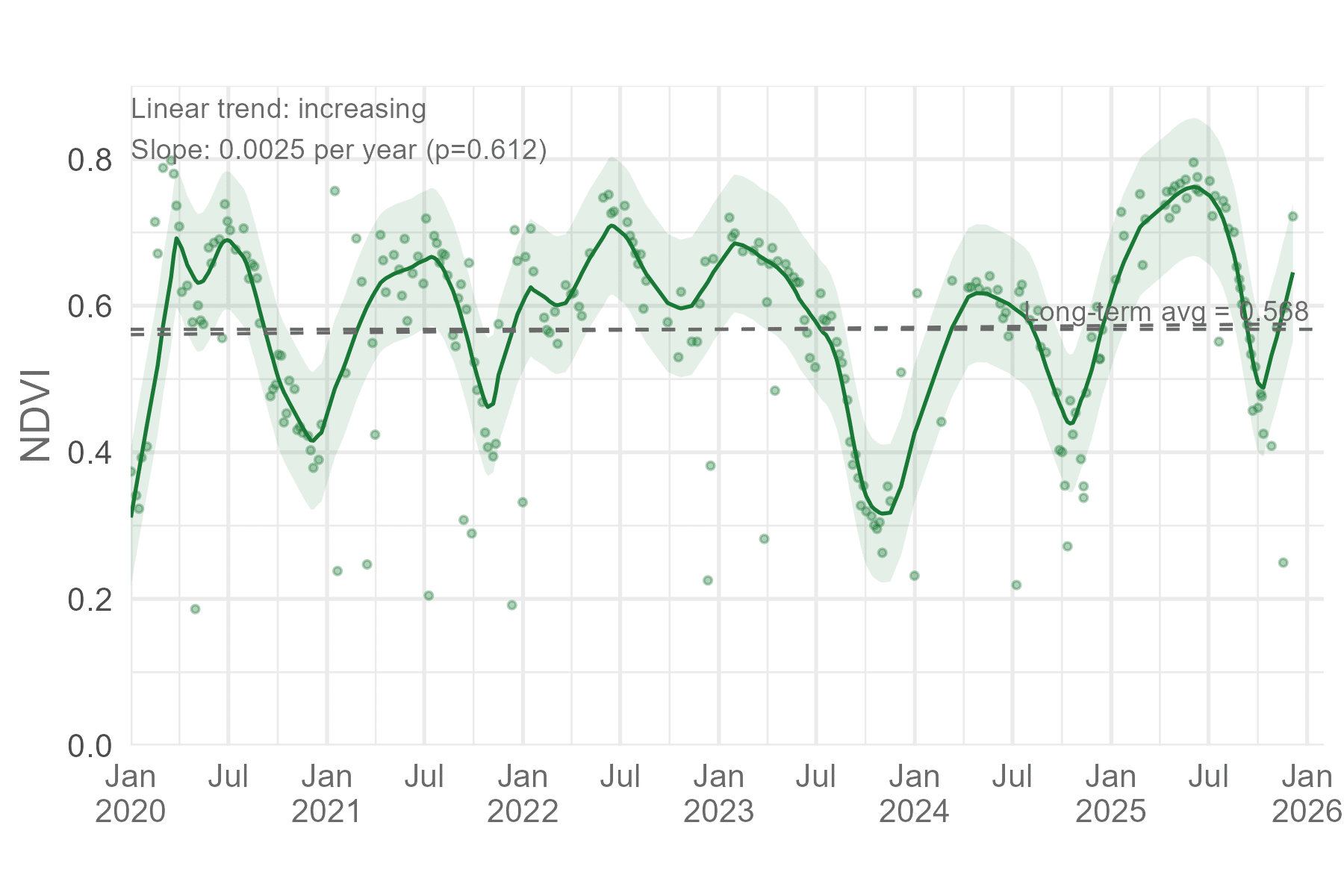
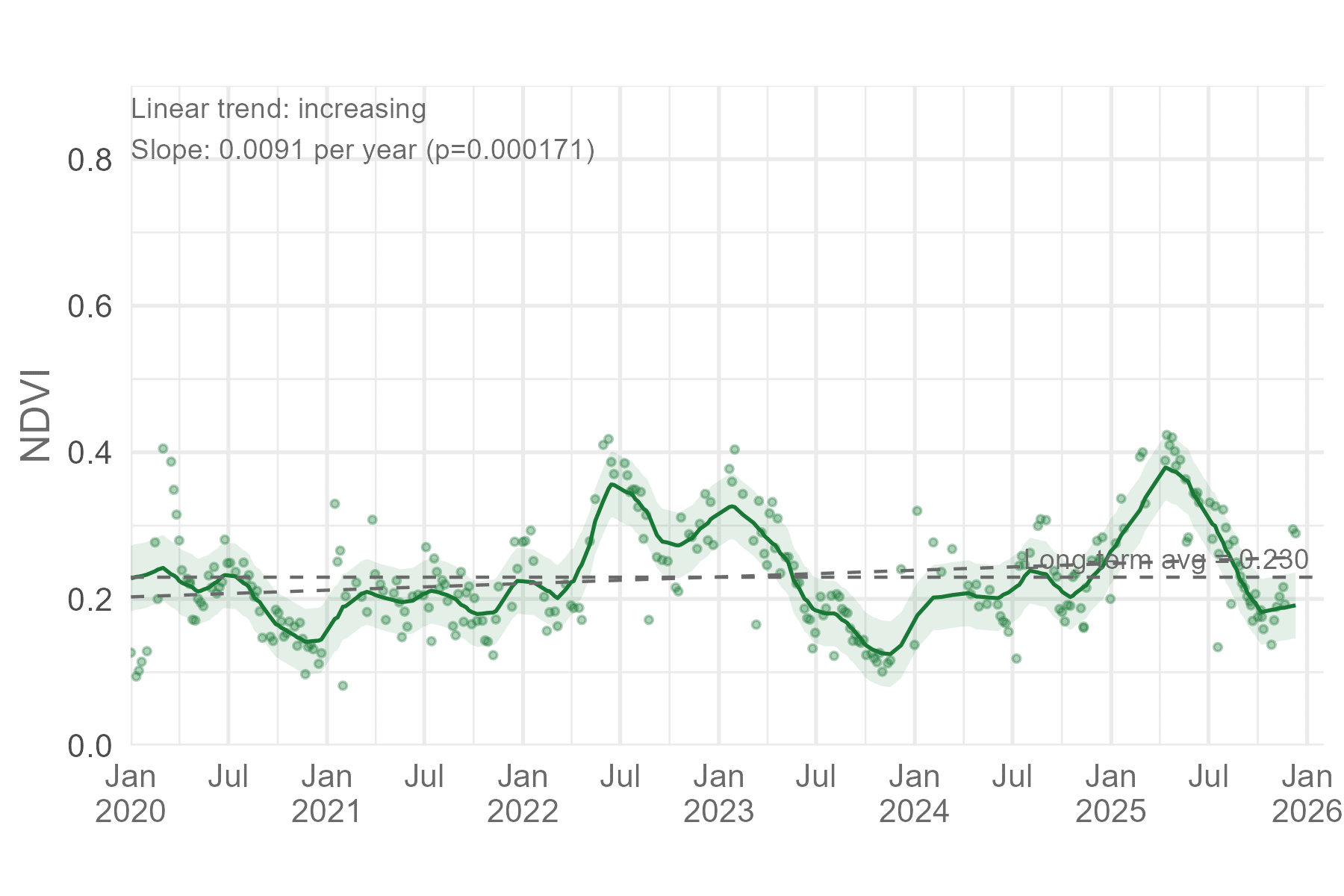
Over the past five years, both sites have been exposed to the same climate variability and seasonal cycles, which is clearly reflected in their vegetation index time series below. The analogue site shows a relatively stable pattern, with consistent seasonal oscillations around a higher long-term average (0.568). The rehabilitation site, by contrast, sits at a much lower baseline (long term average 0.230) and does not have the same seasonality. The rehabilitation site is largely exposed or bare ground over this time period, with some grasses and weeds showing green-up at times.
Importantly, there is only a weak positive trend in the rehabilitation signal over this period. This suggests that the system is still in a very early stage, where meaningful change is limited. What matters at this point is not convergence in magnitude, but the fact that both sites are responding to the same environmental drivers, and that the rehabilitation trajectory can now be interpreted in that shared context.
At this stage, the value of the comparison lies less in demonstrating rehab success, and more in establishing a baseline for how the rehabilitation area behaves relative to its analogue, against which future change can be meaningfully assessed.
What divergence tells us
Just as importantly, divergence from analogue behaviour is often an early warning. We need to look out for when a rehabilitated area:
remains greener for longer than the analogue,
responds too strongly to small rainfall events, or
becomes increasingly volatile through time.
These conditions suggest that different processes are dominating. This can reflect weed-driven dynamics, shallow rooting, poor soil development, or other underlying issues. Crucially, these signals often appear well before problems are obvious on the ground. And they still don’t require species level identification to raise an alert.
Instead, we want to move towards demonstrating that a system is:
trending toward a reference condition,
becoming more stable through time, and
responding appropriately to environmental variability.
This gives us confidence to demonstrate that rehabilitation is on a credible path to closure. Comparing with an analogue site provides a clear, climate-normalised way to do this.

From comparison to confidence
When monitoring focuses on analogue behaviour, confidence comes from context rather than detail.
Instead of asking whether a particular feature (e.g. weed species) can be seen in an image, the question becomes whether the system as a whole is moving in the right direction under real-world conditions. I have previously argued that focusing on counting weeds and species detection can detract from the bigger picture.
This shift does not eliminate the need for field surveys or targeted high-resolution data. It does, however, make those efforts more strategic. We can focus attention where divergence is emerging rather than spreading effort evenly across the landscape or only conducting repeat quadrats / transects.
Ultimately, “Is this area behaving like its analogue?” asks whether rehabilitation is becoming more resilient, more predictable, and more self-sustaining over time. And this is exactly what rehabilitation monitoring is meant to establish.
In the next blog, I’ll look at why answering this kind of question often depends less on spatial resolution than on temporal resolution, and why high frequency is an undervalued dimension in rehabilitation monitoring.